




Expert-backed strategies, daily routines, quick-win checklists and honest answers to the questions every new parent is asking.
Nobody tells you, in those tender, exhausted early weeks of parenthood, that looking after yourself is part of looking after your baby. The feeding schedules, the nappy changes, the cluster feeds at 3am — it all demands so much of you that carving out even ten minutes of alone time can feel impossible, and frankly, indulgent.
But here’s what the research consistently shows: parental wellbeing and child wellbeing are inseparable. When you are rested, emotionally regulated and fulfilled as a person — not just as a parent — your baby benefits directly. This guide is for every first-time parent who knows they need a break but has no idea how to make one happen.
Key Stats:
- 73% of new parents report significant stress in the first year (NHS)
- Just 15 minutes of intentional alone time daily can measurably reduce parental burnout risk
- New parents are 2x more likely to experience postnatal depression without adequate social support (Mind UK)
"Very often, parents assume that taking time for themselves means taking time away from their children. But this isn't true. When we care for ourselves, we are better able to care for our children - and we show them how it's done."
Dr. Lisa Damour, psychologist & child development expert, via UNICEF Parenting
In This Guide
- Why Self-Care for New Parents Actually Matters
- The Real Barriers (And How to Dismantle Them)
- 10 Realistic Strategies to Make Time for Yourself
- Daily Routine Comparison Table
- Your First-Time Parent Self-Care Checklist
- FAQs: Everything You’re Afraid to Ask
- Trusted Resources & Further Reading
Why Self-Care for New Parents Actually Matters
Self-care has a branding problem. The word conjures images of face masks and overpriced candles — which, while pleasant, completely misses the point. For new parents, self-care is closer to basic physiological maintenance: adequate sleep, nourishment, moments of quiet, and connection to your identity outside of parenthood.
UNICEF’s mental health experts describe it simply: “When we are able to meet our own mental and physical needs, it not only benefits our wellbeing, but our children’s as well.” This isn’t motivational fluff — it reflects robust evidence that parental stress is a direct risk factor for infant emotional development.
The NHS also highlights that postnatal depression — which can affect both mothers and fathers — is significantly more common in parents who lack adequate rest, support, and personal space. Think of it like the oxygen mask on a plane: you cannot help others if you have nothing left to give.
Self-care also works as powerful modelling. As Dr. Hina Talib (paediatric adolescent medicine specialist) notes via UNICEF: children who watch their parents manage stress through healthy coping mechanisms — breathing, movement, time with friends — go on to adopt those same tools themselves.
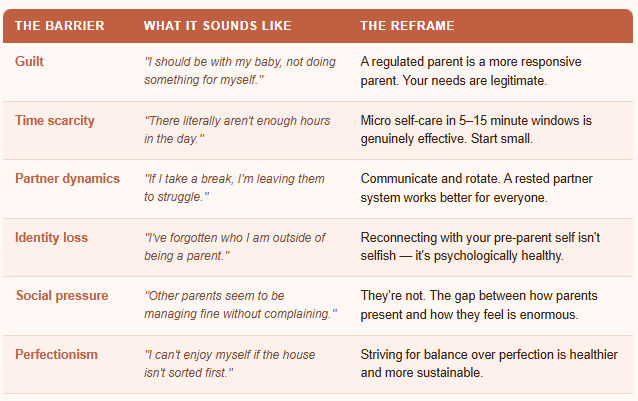
The Real Barriers (And How to Dismantle Them)
Understanding why new parents struggle to prioritise themselves is the first step to doing something about it. The obstacles are rarely logistical – they’re almost always emotional.
10 Realistic Strategies to Make Time for Yourself
These aren’t abstract suggestions – they are practical, parent-tested approaches that work within the real constraints of early parenthood.
Schedule It Like a Medical Appointment
You would never casually cancel a GP appointment. Apply the same commitment to your personal time. Block 15–30 minutes in your calendar - daily if possible, weekly at minimum - and treat it as non-negotiable. Research consistently finds that parents who physically block calendar time are significantly more likely to actually take it than those who wait for "a free moment" (which never arrives).
Schedule It Like a Medical Appointment
You would never casually cancel a GP appointment. Apply the same commitment to your personal time. Block 15–30 minutes in your calendar - daily if possible, weekly at minimum - and treat it as non-negotiable. Research consistently finds that parents who physically block calendar time are significantly more likely to actually take it than those who wait for "a free moment" (which never arrives).
Build a Tag-Team System with Your Partner
If you have a co-parent, establish a clear rotation: one evening you take a break while they handle bedtime; next evening, you swap. This works only if it's explicitly agreed, not assumed. Have the conversation directly and revisit it regularly as your baby's needs change. Both of you deserve solo time, and building that in structurally prevents resentment building up on either side.
Protect Your Mornings (Even Briefly)
Many new parents find that waking 20–30 minutes before the baby gives them a psychological head start on the day. Use it however you choose, journalling, stretching, a hot drink in silence. This isn't about productivity; it's about beginning the day as yourself before the demands begin. If your baby's sleep is unpredictable, don't force this - adapt it to your circumstances.
Treat Sleep as Non-Negotiable Self-Care
Sleep is, as psychologist Dr. Lisa Damour describes it, "the glue that holds human beings together." In the early months, sleep deprivation can compromise everything from mood regulation to immune function. Prioritise sleep over almost any other self-care activity. Where possible, sleep when the baby sleeps - especially in the first three months. Ask for help at night when you need it.
Move Your Body - Any Amount Counts
Exercise is one of the most evidence-backed tools for managing parental stress, anxiety and low mood. But it doesn't need to look like a gym session. A 15-minute walk with a pram counts. A yoga video during nap time counts. Gentle postnatal movement classes count. Even brief bouts of movement release endorphins and help interrupt the stress cycle.
Build "Pause Rituals" Into Your Day
Clinical psychologist Sonali Gupta describes what she calls "Pause Rituals" - conscious moments of pause followed by something self-soothing at a physical, mental or social level. This might be five minutes of deep breathing after a feed, putting your phone down and looking out the window with a drink, or spending two minutes writing down one thing you're grateful for. These are not trivial practices - they build genuine psychological resilience over time.
Use Technology Wisely (and Set Limits on It)
Technology can either steal your free time or help create it. On the helpful side: grocery delivery saves a weekly trip; meal planning apps reduce decision fatigue; smart baby monitors give you peace of mind during a rest. On the draining side: endless social media scrolling leaves most parents feeling worse, not better. Set screen time limits for yourself, turn off non-essential notifications, and be intentional about what you consume during your personal time.
Invest in Social Connection
Isolation is one of the defining challenges of early parenthood, particularly for those who have left a workplace or social scene. Actively maintaining friendships, even just a voice note, a quick call, or a postnatal group meeting, is clinically protective. Research consistently shows that social support is one of the strongest buffers against postnatal depression and anxiety for both mothers and fathers. You don't need to socialise extensively - you need consistent, genuine connection.
Learn to Ask for Help - and Accept It
Asking for help is not a sign of failure; it is a sign of self-awareness. Whether it's a family member taking the baby for an hour, a friend bringing dinner, or seeking professional support from a GP or therapist, accepting help is part of your self-care toolkit. As UNICEF's Dr. Hina Talib notes: "Self-care can mean asking for help when you need it - at home, at work, from family, and sometimes from therapists or other mental health clinicians."
Your First-Time Parent Self-Care Checklist
Use this as a gentle weekly audit, not a rigid to-do list. Tick off what you’ve managed; notice, without judgment – what you haven’t.
Physical Foundations
- I have slept for at least one uninterrupted stretch this week
- I have eaten at least one proper, seated meal today
- I have had some form of physical movement in the past 48 hours
- I have been outside in daylight at least once today
- I have drunk enough water today
Mental & Emotional Health
- I have had at least 10 minutes of genuine alone time this week
- I have talked to another adult (not about baby admin) this week
- I have done something purely for my own enjoyment this week
- I have noticed and named my emotions rather than suppressing them
- I haven’t been unkind to myself when things haven’t gone to plan
Support System
- I have communicated my needs to my partner or support person this week
- I have accepted help when it was offered (or asked for it)
- I know where to turn if I feel overwhelmed (GP, NCT, Samaritans, a friend)
Planning Ahead
- I have something to look forward to in the next 7 days – however small
- I have scheduled at least one block of personal time in the coming week
- I have one self-care activity I’m planning to try or continue this week
Remember: The most important thing you can do for your child right now is to keep showing up - and you can only do that sustainably if you look after yourself too. Small steps, consistently taken, are enough. You're doing better than you think.
FAQs: Everything You're Afraid to Ask
Is it selfish for new parents to want time alone?
No. Taking time for yourself as a new parent is not selfish - it is necessary. When you care for your own mental and physical health, you show up as a calmer, more patient and more present parent. Experts at UNICEF, Mind and the NHS consistently note that self-care benefits the whole family, not just the individual. Guilt is a normal feeling; acting on it by never resting is what causes long-term harm.
How much alone time do new parents actually need?
There's no universal number, but even 15–30 minutes of intentional, restorative alone time daily can make a measurable difference. The keyword is intentional - scrolling social media doesn't count. What matters is that you're genuinely disengaging from parenting demands and doing something that feels replenishing to you.
What actually counts as self-care for new parents?
Much more than most people think. Sleep, eating properly, gentle movement, a phone call with a friend, a shower without someone crying outside the door, listening to a podcast you enjoy, all of this is self-care. It doesn't need to be elaborate. Small, consistent acts of self-restoration are more valuable than occasional grand gestures.
How can single parents find time for themselves?
Single parents face a harder version of this challenge, but it isn't impossible. Trusted family members, friends, and local parent groups can provide cover. Some single parents arrange informal childcare swaps with other parents. Nap times and educational screen time (age-appropriately) can create short windows. And it's worth asking, directly - for specific help rather than hoping people will offer. You are allowed to need support.
My partner and I argue about whose turn it is to get a break. How do we solve this?
Reframe it: taking time for yourself is an investment in your baby's wellbeing, not a withdrawal from it. A rested, fulfilled parent is demonstrably better for infant development than an exhausted, depleted one. The guilt may never fully disappear, but it doesn't have to drive your decisions. Your needs are real, they matter, and meeting them makes you a better parent.
How do I stop feeling guilty for taking time away from my baby?
This is one of the most common relational flashpoints in early parenthood. The answer is to make it structural rather than spontaneous. Agree on a weekly schedule that explicitly assigns each person their solo time, in advance, not in the moment. Write it down. Treat it as equally important for both of you. When it's scheduled, it stops being a negotiation and starts being a system.
Trusted Resources & Further Reading
- UNICEF Parenting: Self-Care for Parents — unicef.org/parenting/mental-health/parent-self-care-tips
- NHS: Postnatal Depression Support — nhs.uk/conditions/post-natal-depression
- Mind UK: Perinatal Mental Health — mind.org.uk
- NCT (National Childbirth Trust): Life as a Parent — nct.org.uk
- Samaritans — samaritans.org · Free, confidential support 24/7: call 116 123
This article is written for informational purposes and does not constitute medical advice. If you are experiencing significant mental health difficulties, please contact your GP or a qualified healthcare professional.








)