

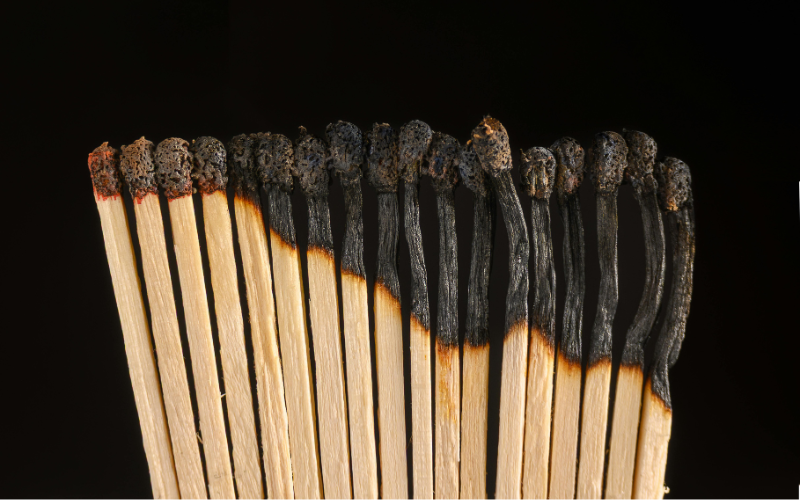

What parental burnout really is, how to recognise it in yourself, and how to begin, slowly, honestly, to recover.
You love your children. And you are exhausted by them. Both of those things can be completely true at the same time – and that paradox is at the heart of what parental burnout actually feels like from the inside. If you’ve found yourself snapping over small things, going through the motions of bedtime routines without feeling emotionally present, or lying awake at night with an overwhelming sense of dread about tomorrow – you’re not a bad parent. You may be a burned-out one.
Parental burnout is a recognised psychological condition, not a character flaw. It affects parents across all demographics, income levels, family structures, and parenting styles. The research is clear that it's driven by sustained imbalance between parenting demands and available resources - not by how much you care. In fact, it most commonly affects parents who care deeply.
~14%
of parents show clinically significant levels of parental burnout, according to international research
2×
more likely to experience burnout: parents with perfectionist tendencies or high self-imposed standards
67%
of burned-out parents report feeling emotionally distant from their children, a symptom, not a sign of bad parenting
What Parental Burnout Actually Is
The term “burnout” gets used loosely, but clinical parental burnout is something specific. Researchers Isabelle Roskam and Moïra Mikolajczak, who have published extensively on the subject, define it as a distinct syndrome with four core dimensions that set it apart from general stress and burnout in the workplace:
The four dimensions of parental burnout (Roskam & Mikolajczak, 2018)
- Emotional exhaustion in the parenting role – feeling completely drained by parenting, often from the moment you wake up
- Emotional distancing from your children – caring for them mechanically, without the warmth you know you’re capable of
- Loss of parental efficacy – a diminishing sense that you’re doing this well or that it matters
- Contrast with your former parenting self – a painful awareness of who you used to be as a parent versus who you are now
Critically, parental burnout is distinct from general depression, though the two can coexist. A person experiencing burnout may feel entirely capable and even content in other areas of their life – at work, with friends, in their hobbies – but depleted the moment they step into the parenting role. According to Mind UK’s guidance on stress and mental health, this kind of role-specific exhaustion is a key feature that distinguishes burnout from clinical depression.
It’s also worth understanding what creates parental burnout, because that understanding is the first step toward changing it. At its core, burnout emerges when the demands of parenting chronically outweigh the resources available to meet them. Those resources include time, support, rest, a sense of identity outside the parenting role, and – critically – emotional recovery.
Signs of Burnout to Watch For
One of the most insidious things about parental burnout is how gradually it creeps in. Most parents dismiss the early signs as normal tiredness, adjusting expectations, or “a rough patch.” By the time the emotional exhaustion becomes undeniable, it’s often been building for months.
Here are the signs worth taking seriously, not to diagnose yourself, but to give yourself permission to acknowledge what you’re experiencing.
Dreading your own home
Feeling a sinking sensation when you pull into the driveway, or relief when the children are asleep — not because you don’t love them, but because you have nothing left.
Emotional flatness
Going through the motions of bath time, stories, dinner, with no emotional presence behind it. Feeling like an observer of your own parenting rather than a participant.
Disproportionate irritability
Snapping at small things, a spilled drink, a repeated question, with an intensity that surprises even you. Followed by crushing guilt.
Chronic physical exhaustion
Tiredness that doesn’t improve with sleep. Waking already depleted. Frequent headaches, low immunity, tension in the body that doesn’t release.
Social withdrawal
Cancelling plans, avoiding conversations, retreating from friendships. Ironically, pulling away from the very support systems that could help.
A lost sense of self
No longer knowing who you are outside the parenting role. Struggling to remember what you used to enjoy, or feeling guilty for wanting those things back.
Fantasy of escape
Recurring thoughts of simply leaving — not from malice, but from an overwhelming desire to rest. These thoughts are more common than parents admit, and they are a symptom, not a verdict.
Deep shame and secrecy
Hiding how you’re feeling because the gap between “good parent” and “how I actually feel” seems too wide to bridge. Shame keeps burnout in place.
If you are experiencing thoughts of harming yourself, your children, or leaving your family permanently - please reach out to your GP, call Samaritans on 116 123 (free, 24/7), or visit your nearest A&E. These thoughts can feel frightening, but having them doesn't make you dangerous - it means you need support right now.
Why Parenting Feels This Hard Right Now
Understanding the structural reasons behind the burnout epidemic can be genuinely relieving. When you realise your suffering isn’t a personal failing but a predictable response to impossible conditions, something shifts.
"Burnout is not a sign that you care too little. It's a sign that you've been trying to give what you don't have for too long."
— Dr. Moïra Mikolajczak, UCLouvain Centre for Psychology of Health
Modern parenting carries a set of pressures that previous generations simply didn’t face in the same way. The Mental Health Foundation’s research on parenting and mental health points to several converging factors:
- Parenting has become more intensive. Cultural expectations around what “good parenting” looks like have shifted dramatically — toward constant engagement, stimulation, enrichment, and emotional attunement. This is exhausting even when it’s well-intentioned.
- Support systems have thinned. Extended family support, community networks, and informal childcare have eroded for many families. The village that was once available to raise a child has, for many parents, largely disappeared.
- Financial pressure compounds everything. The cost of living, housing insecurity, and the stress of dual-income households create a baseline of anxiety that depletes emotional reserves before the parenting even begins.
- Social media creates an impossible comparison. Parents are now exposed to a curated version of other families’ lives at scale, making their own messy reality feel like evidence of inadequacy.
None of this is your fault. All of it matters for recovery, because recovery means changing the conditions — not just developing more resilience to absorb them.
Building Emotional Resilience - What It Actually Means
The word “resilience” can feel like another demand placed on already depleted parents – as though the solution to burnout is simply to become tougher. That’s not what emotional resilience means in this context.
Real emotional resilience is about recovering faster, not tolerating more. It’s about building the internal and external infrastructure that means difficult stretches don’t send you all the way down – and that you have a way back when they do.
Emotional awareness
Noticing your emotional state before you hit the wall. Learning your own early warning signs, irritability, withdrawal, hypervigilance, so you can respond before depletion sets in.
Recovery rhythm
Building regular, non-negotiable recovery into your week, not as a reward for coping, but as the infrastructure that makes coping possible. Even 30 minutes of genuine restoration matters.
Connected identity
Maintaining a sense of who you are beyond the parenting role. Parents with a stronger non-parenting identity show significantly greater resilience in the research literature.
Flexible standards
The ability to consciously lower your expectations in hard periods, and raise them when you have more capacity, rather than holding a fixed standard regardless of circumstances.
Mind’s guidance on understanding stress is a valuable resource for anyone beginning to explore the relationship between chronic stress, burnout, and long-term mental health — written accessibly and grounded in evidence.
If you need support right now
You do not need to be in crisis to ask for help. If you are struggling, these organisations can offer support specifically for parents:
Family Lives: familylives.org.uk — free helpline: 0808 800 2222 (Mon–Fri, 9am–9pm; Sat–Sun, 10am–3pm)
Samaritans: samaritans.org — free, 24/7: 116 123. For any time you need to talk.
NHS Talking Therapies: Self-refer online — free CBT and counselling without needing a GP referral.
PANDAS Foundation (perinatal mental health): pandasfoundation.org.uk — helpline: 0808 1961 776
Frequently Asked Questions
What is parental burnout?
What are the signs of parental burnout?
Is parental burnout the same as depression?
How do I recover from parental burnout?
How can I build emotional resilience as a parent?
When should a parent seek professional help for burnout?
Sources & Further Reading
- Roskam, I. & Mikolajczak, M. (2018). Parental burnout: Moving the focus from children to parents. New Directions for Child and Adolescent Development. ncbi.nlm.nih.gov
- Mental Health Foundation. (2024). Parenting and mental health. mentalhealth.org.uk
- Mind UK. (2024). Stress: Signs, symptoms and causes. mind.org.uk
- American Psychological Association. (2023). Parenting and burnout. apa.org
- Neff, K. (2023). Self-compassion research. self-compassion.org
- NHS. (2024). Breathing exercises for stress. nhs.uk
- NHS. (2024). NHS Talking Therapies (formerly IAPT). nhs.uk
- Family Lives. (2024). Support for parents. familylives.org.uk